
Evolution of Orthodontic Biomechanics
Evolution_of_Orthodontic_Biomechanics (1) [...]
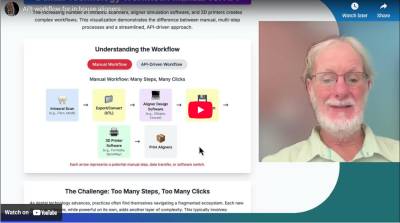
API for Orthodontic Diagnosis and Treatment Planning
Creating an API to simplify the worflow to produce orthodontic aligners is of great importance to further enhance the implementation of this great technology. 3D direct printing will speed up the process while significantly increasing capabilities and improving outcomes. We are already in prototype stages and will hopefully create our first API soon. An API (Application Programming Interface) is a digital connector that allows different orthodontic software systems to "talk" to each other and a [...]
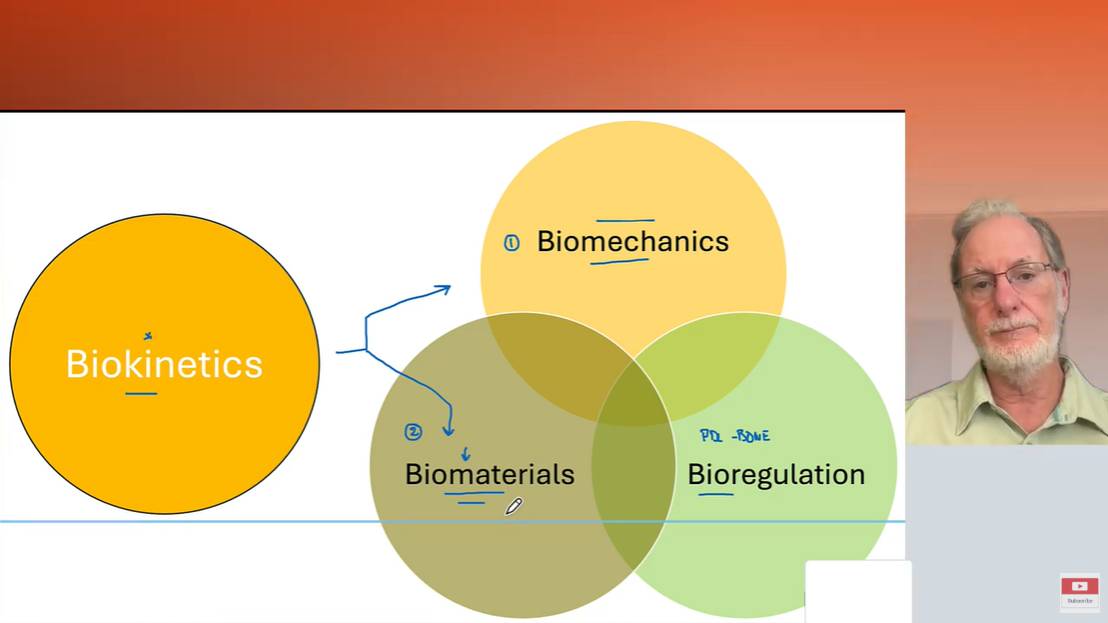
Biokinetics for Aligner Treatment
Biokinetics, biology, biomechanics, and biomaterials are tightly interdependent in 3D printed aligner treatment. Biokinetics describes how teeth actually move over time under a given force system—rate, sequence, and efficiency of movement—reflecting the underlying biology of bone remodeling, periodontal ligament response, and each patient’s healing capacity. Biomechanics defines the force and moment systems we intend to deliver (magnitude, direction, point of application, and moment-to-force ra [...]
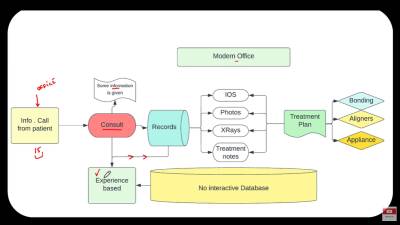
Ai Driven Orthodontic Practice
An AI-driven orthodontic practice is a clinical environment in which artificial intelligence tools are integrated into every major step of care—diagnosis, treatment planning, appliance design, monitoring, and practice management—to support faster, more precise, and more personalized decisions than a human team could routinely achieve alone. In practical terms, an AI-driven practice typically uses: Automated image and scan analysis (ceph/CBCT/IOS segmentation, landmarking, skeletal/dental measur [...]
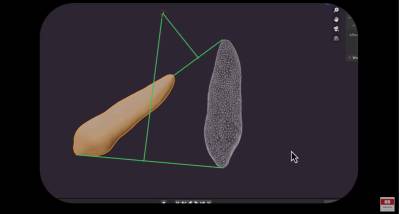
Center of Rotation vs Region of Rotation in Orthodontics
Center of rotation (Crot)In orthodontic biomechanics, the center of rotation is the point in or near a tooth (or segment of teeth) about which the tooth appears to pivot for a given loading condition. More precisely:If you look at the initial displacement pattern produced by a specific force–moment system, you can always describe that motion as a pure rotation about one point in space. That point is the center of rotation. Key features: It depends on the applied forces and moments (especially t [...]
API for Orthodontics
An API (Application Programming Interface) is a defined set of rules and data formats that allows different software systems to communicate with each other in a predictable, secure, and standardized way. Instead of one program needing to know how another is built internally, it simply sends structured requests (for example, “give me this patient’s images” or “run this analysis on this dataset”) to the API and receives structured responses in return. This separation makes it easier to connect, e [...]
Ai in Diagnosis – The A stands for Assisted
AI and APIs have the potential to act as a smart “front end” for orthodontic diagnosis, filtering and organizing information before the orthodontist even sits down to plan a case. AI-driven tools can automatically segment intraoral scans and CBCTs, generate preliminary cephalometric analyses, flag asymmetries or impacted teeth, and suggest likely malocclusion categories based on patterns learned from large datasets. Through APIs, these outputs can flow directly into practice management and treat [...]
Biomechanics of Aligners
The biomechanics of aligners are primarily displacement-driven: you program a small positional change in the virtual setup, then rely on the elastic deformation of the plastic to generate forces and moments when the aligner is seated. As the aligner tries to rebound to its original shape, it delivers a system of forces and couples to the teeth, whose quality depends on the aligner’s thickness, material, edge design, and how well it grips the crown. Attachments, bite ramps, and power ridges modif [...]