
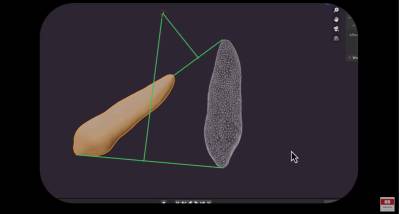
Center of rotation (Crot)
In orthodontic biomechanics, the center of rotation is the point in or near a tooth (or segment of teeth) about which the tooth appears to pivot for a given loading condition.
More precisely:
If you look at the initial displacement pattern produced by a specific force–moment system, you can always describe that motion as a pure rotation about one point in space. That point is the center of rotation.
Key features:
-
It depends on the applied forces and moments (especially the moment-to-force ratio at the center of resistance).
-
It is not fixed to the tooth anatomy; it can be located at the apex, between crown and root, beyond the apex, or even outside the tooth.
-
It is defined for that particular instant / loading configuration. If the force system changes (e.g., as an aligner relaxes or a wire deactivates), the center of rotation shifts.
Axes of rotation
The axis of rotation is the line in 3D space about which the tooth rotates for that instantaneous displacement.
In a simplified 2D view (e.g., sagittal plane):
-
The axis of rotation is perpendicular to the plane you are looking at, passing through the center of rotation.
-
For example, labiolingual tipping is often drawn in the sagittal plane; the axis of rotation is a line running mesiodistally through the center of rotation.
In full 3D orthodontic biomechanics, you can describe axes of rotation around:
-
Anteroposterior axis (producing buccolingual tipping, “torque”)
-
Vertical axis (producing mesiodistal rotation of the crown)
-
Transverse axis (producing intrusion/extrusion with tipping)
Clinically, when we say “root torque” or “rotation of a premolar,” we are really talking about different orientations of these axes and different locations of the center of rotation relative to the root and crown.
Region of rotation
For simple, rigid-body mechanics we act as if a tooth has a single, well-defined center and axis of rotation. In reality, especially with viscoelastic systems (PDL, bone remodeling, aligners with non-uniform stiffness), the movement can be more complex:
-
Different parts of the root may experience slightly different instantaneous centers of rotation.
-
The strain field in the PDL is not perfectly consistent with a single pivot point.
Because of that, some authors prefer to talk about a region of rotation:
-
A small zone within or around the root where the “effective” center of rotation lies, rather than a single mathematical point.
-
This is particularly relevant for aligner biomechanics, where variable stiffness of the plastic, attachments, and contact points create spatially varying force and moment fields.
So, in short:
-
Center of resistance: where the net force acts with no rotation.
-
Center of rotation: where the tooth appears to pivot under a given force system.
-
Axis of rotation: the 3D line about which that rotation occurs.
-
Region of rotation: a realistic concept acknowledging that, in biological, viscoelastic systems, the effective center/axis is better understood as a small zone rather than a single perfect point.

Leave A Comment
You must be logged in to post a comment.