
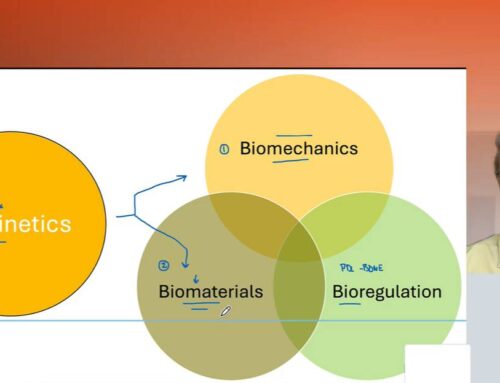
Biometry of aligners sits at the intersection of biology, biomechanics, and biomaterials, turning aligners into measurable treatment sensors rather than passive plastic shells. From a biological standpoint, the rate and pattern of tooth movement reflect the patient’s individual response to force, so tracking fit, lag, and refinement needs over time provides indirect metrics of bone remodeling and periodontal adaptation. Biomechanically, planned versus achieved tooth positions, attachment engagement, and aligner deformation can be quantified to infer delivered forces, moments, and moment-to-force ratios, highlighting when mechanics are drifting from the intended pathway. On the biomaterials side, the viscoelastic properties, thickness, and aging of the polymer influence how much of the prescribed displacement is actually converted into effective force over the wear interval. Integrating these three dimensions into a unified “aligner biometry” framework would allow clinicians to monitor treatment in a data-driven way, adjusting staging, wear time, or appliance design in response to objective performance metrics rather than relying solely on visual inspection and intuition.
Biometry of Aligners
Share This Story, Choose Your Platform!
About the Author: Jean-Marc Retrouvey

Related Posts


Leave A Comment
You must be logged in to post a comment.