
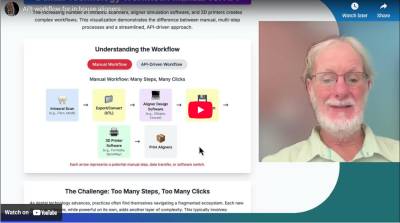
An API (Application Programming Interface) is a defined set of rules and data formats that allows different software systems to communicate with each other in a predictable, secure, and standardized way. Instead of one program needing to know how another is built internally, it simply sends structured requests (for example, “give me this patient’s images” or “run this analysis on this dataset”) to the API and receives structured responses in return. This separation makes it easier to connect, extend, and update software systems without breaking everything else.
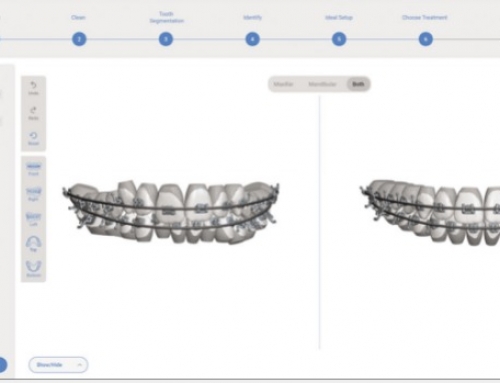
In orthodontic diagnosis, an API can act as the “bridge” between intraoral scanners, CBCT viewers, practice management systems, and AI/ML diagnostic tools. For example, an orthodontic planning platform could use an API to automatically pull DICOM data and STL files from the imaging server, send them to an AI segmentation or cephalometric analysis service, and then receive back labeled anatomy, measurements, and risk scores directly into the clinician’s planning interface. This reduces manual file handling, decreases transcription errors, and enables more advanced workflows such as real-time comparison of different treatment options, automated severity indices, or decision-support dashboards that combine skeletal, dental, soft tissue, and functional data within a single diagnostic environment

Leave A Comment
You must be logged in to post a comment.