
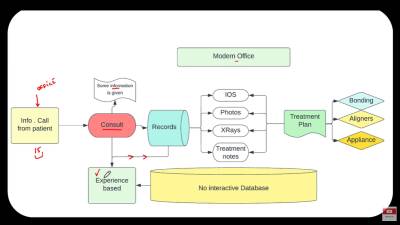
An AI-driven orthodontic practice is a clinical environment in which artificial intelligence tools are integrated into every major step of care—diagnosis, treatment planning, appliance design, monitoring, and practice management—to support faster, more precise, and more personalized decisions than a human team could routinely achieve alone.
In practical terms, an AI-driven practice typically uses:
-
Automated image and scan analysis (ceph/CBCT/IOS segmentation, landmarking, skeletal/dental measurements).
-
Decision-support systems that suggest differential diagnoses, classify malocclusions, and propose treatment options based on large case datasets.
-
AI-assisted treatment planning and appliance design (e.g., aligner staging, attachment design, arch form optimization, force/torque estimation).
-
Intelligent monitoring tools (remote photo/scan review, early relapse detection, compliance and hygiene alerts).
-
Predictive analytics for scheduling, no-show risk, treatment duration, and resource utilization.
The key idea is not replacing the orthodontist, but using AI to offload repetitive analytic tasks, reveal biomechanical and biological patterns that are hard to see manually, and give the clinician better, data-driven information at the moment of decision.


Leave A Comment
You must be logged in to post a comment.