
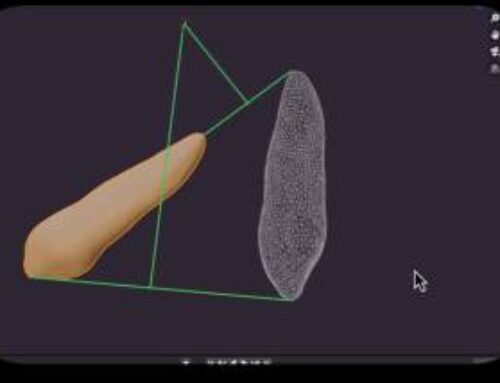
When retracting canines into an extraction space, the required moment-to-force (M/F) ratio for good root control depends on the initial angulation of the tooth. For an upright canine, you use the “classic” M/F ratio for translation, generating a counter-moment just large enough to keep the root moving with the crown rather than tipping. If the canine is mesially angulated, the line of action of the distal retraction force tends to help upright the tooth, so a lower M/F ratio is often sufficient and some controlled tipping can even be desirable early on. In contrast, a distally angulated canine has its crown already leaning into the space, so the same retraction force produces a larger tipping moment; in this situation, you need a higher M/F ratio (or a more apical/distal force application, e.g., with power arms or TADs) to avoid excessive distal crown tipping and to achieve proper root parallelism.
Canine retraction with different angulations
Share This Story, Choose Your Platform!
About the Author: Jean-Marc Retrouvey

Related Posts
Leave A Comment
You must be logged in to post a comment.