
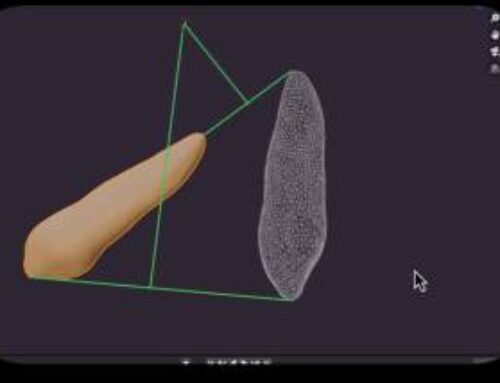
The biomechanics of aligners are primarily displacement-driven: you program a small positional change in the virtual setup, then rely on the elastic deformation of the plastic to generate forces and moments when the aligner is seated. As the aligner tries to rebound to its original shape, it delivers a system of forces and couples to the teeth, whose quality depends on the aligner’s thickness, material, edge design, and how well it grips the crown. Attachments, bite ramps, and power ridges modify where and how the plastic engages the tooth, shifting the line of action closer to or farther from the center of resistance to tune tipping, translation, torque, and intrusion. Because the material is viscoelastic and forces decay over time, effective biomechanics with aligners rely on careful staging, control of force magnitude through small, incremental movements, and strategic use of anchorage to keep side effects within biologically acceptable limits.
Biomechanics of Aligners
Share This Story, Choose Your Platform!
About the Author: Jean-Marc Retrouvey

Related Posts
Leave A Comment
You must be logged in to post a comment.